Terv PresszóTerv Presszó
Reserve a Table
Living museum

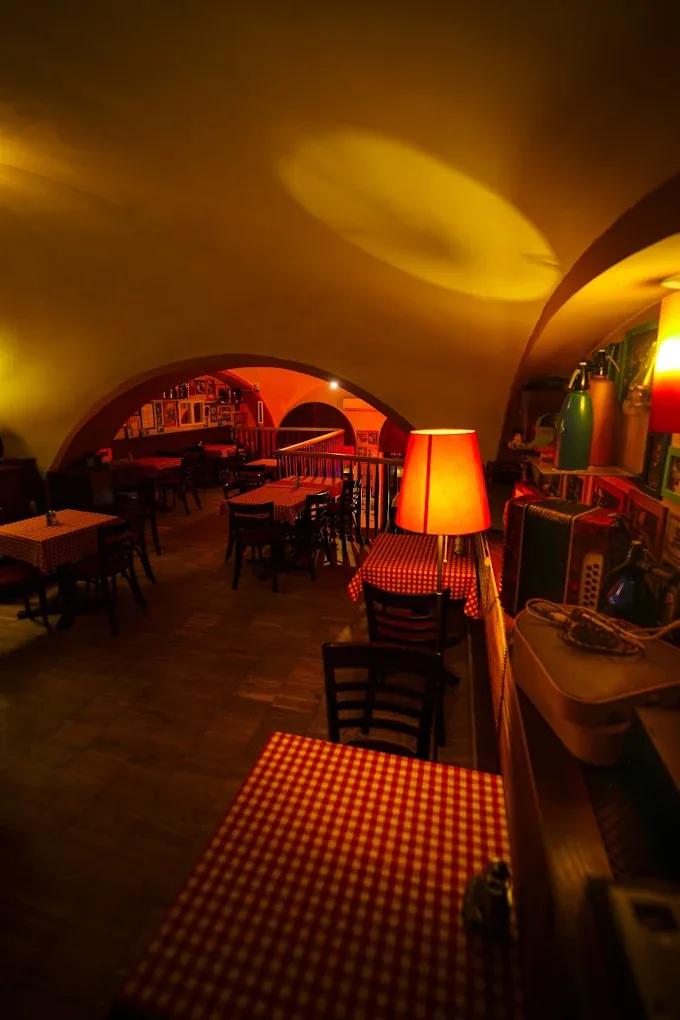
The room
is the exhibit.

Terv Presszó is a Budapest presszó that kept its walls. Eight objects, eight short stories, and a QR plate next to each one.

Come in, look around, and let a bowl of goulash be your ticket.

Open daily, noon to midnight.

  1. LookFind a plate next to an object, on the wall or by the counter.
  2. ScanPoint your phone camera at the QR code. The story opens in a few seconds, no app needed.
  3. EatSit down and order. One dish is the whole ticket, and the room is yours for as long as you like.
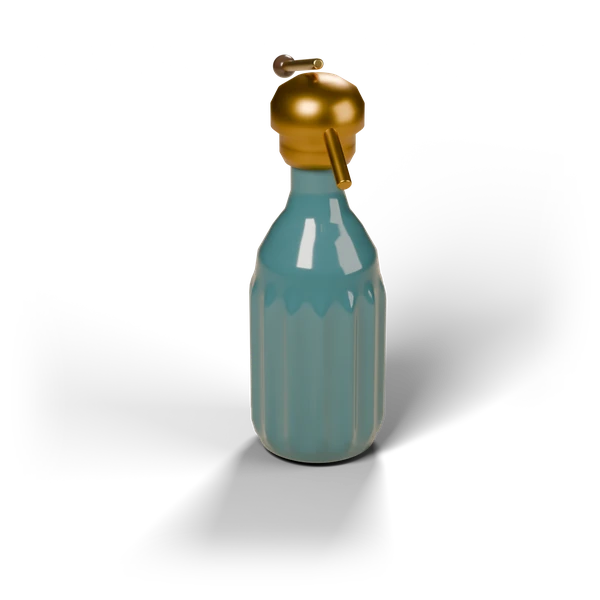
The Soda Siphon. Illustration. Stylised model, not the venue's own object.
Illustration. Stylised model, not the venue's own object.
Living museum

What a presszó was

A presszó was a small café built around one machine. In the 1950s the espresso maker arrived in Budapest in numbers, and a new kind of place grew up around it: a narrow room, a counter, a few high tables, coffee served in small cups and often drunk standing. The word itself is a clipped form of eszpresszó. A presszó was not the grand coffee house of marble tables and newspapers; it was quick, loud and close to the street. People came in for a dupla, a raspberry syrup with soda from the siphon or a fröccs of wine and soda, and stayed to talk. The radio behind the counter carried the news at set hours and, on match days, the football; in the years of the Golden Team every table had an opinion about the line-up.

This room keeps that scale and that rhythm. The objects stay where they are, on the walls and by the counter. Instead of glass cases there are QR plates: read the story, then order something and stay a while.

The room.
The room.

The Soda Siphon

The Soda Siphon. Illustration. Stylised model, not the venue's own object.
A szódásszifon
Look closerLook at the lever on the head: one press opens the valve, and the pressure inside does the rest.

In the golden age of the presszó, soda water never came from a bottle: it came from a siphon. Every spritzer and raspberry syrup drink in Budapest started with a head like this one. Ours is not a prop: thousands of these circulated through the city's cafés, and this one is ours.

Hungary's soda-water craft dates back to the 1800s, and it lived on every street corner like this.

  • Since the 1800s
  • Glass in a wire or metal jacket, later steel or aluminium
  • Fröccs and raspberry soda
Read more: How it works · The soda trade · The drinks

How it works

A soda siphon is a pressure vessel with a head. Inside the bottle sits water charged with carbon dioxide, and a tube runs from the head down to the bottom. Press the lever and the gas pressure pushes the water up the tube and out of the spout, while the rest stays sealed and fizzy until the next glass.

The soda trade

Early siphons were thick glass in a wire or metal jacket, because the pressure inside could shatter a weak bottle; later ones were made of steel or aluminium. In Hungary soda water has its own word, szikvíz, and it had its own trade. Soda men delivered filled siphons by cart to cafés and homes, collected the empties and refilled them at small local works, so a single head could travel for years.

The drinks

The drinks made with it are still ordered today. Fröccs is wine with soda, and its versions are named by ratio, from the kisfröccs at one part wine to one part soda to the hosszúlépés with twice as much soda as wine. Raspberry syrup with soda was the children's order in every presszó.

The Enamel Signs

The Enamel Signs. Illustration. Stylised model, not the venue's own object.
A zománctáblák
Look closerFind a chipped edge: the dark line under the colour is the steel plate the glass was fused to.

Enamel signs were the billboards of their era: no pixels, no updates, just baked colour that survived decades of rain and sun. The pieces on our walls are pieces of the Hungarian enamel craft, still as vivid as the day they were fired.

Go ahead and photograph them: they have already outlived every trend.

  • Fired at about 800 degrees Celsius
  • Glass fused to steel
  • On our walls
Read more: From steel to glass · One colour at a time · The Hungarian trade

From steel to glass

An enamel sign starts as a sheet of steel. The plate is cut to shape, cleaned and coated with a ground layer of finely powdered glass, then fired in a kiln at roughly 800 degrees Celsius until the powder melts into a smooth skin.

One colour at a time

Each colour is a separate step: the design is laid on through stencils or screens, one colour at a time, and the plate goes back into the kiln after every layer, so a sign with five colours may be fired six or seven times. Because the colour is glass fused to metal, it does not fade in sunlight and rain runs off it; the usual damage is a chip at the edge where the steel shows through and rusts.

The Hungarian trade

Hungary had a strong enamel industry in the twentieth century, with works such as the one in Bonyhád known well beyond the country, and enamelled steel was used for cooking pots, house numbers, street plates and advertising alike. Signs like these hung outside shops and inside bars for decades, which is why so many survive with their colours intact.

The Golden Team Wall

The Golden Team Wall. Illustration. Stylised model, not the venue's own object.
Az Aranycsapat-fal
Look closerCount the players on the wall and try to name the eleven in order. Many Hungarians still can.

25 November 1953. Wembley. England 3, Hungary 6: the day the world learned the name Ferenc Puskás. The house dates its opening to the year after that match, and this wall honours the football legends every presszó table argued about back then.

Stand in front of it and imagine: here, games like that were "watched" on the radio.

  • 25 November 1953, Wembley
  • England 3, Hungary 6
  • On the wall
Read more: The team · Wembley and Bern · The eleven

The team

The Golden Team, Aranycsapat in Hungarian, is the name given to the national side of the early 1950s. Under coach Gusztáv Sebes it won Olympic gold in Helsinki in 1952 and went more than four years without losing a match.

Wembley and Bern

On 25 November 1953 it played England at Wembley, where England had never lost at home to a team from outside the British Isles, and won 6 to 3: three goals from Nándor Hidegkuti, two from Ferenc Puskás, one from József Bozsik. The return match in Budapest on 23 May 1954 ended 7 to 1. Six weeks later, on 4 July 1954, Hungary lost the World Cup final in Bern to West Germany, 3 to 2, after leading 2 to 0.

The eleven

The regular line-up is still recited from memory by many Hungarians: Grosics, Buzánszky, Lóránt, Lantos, Bozsik, Zakariás, Budai, Kocsis, Hidegkuti, Puskás, Czibor. The matches reached most people through the radio and the voice of the commentator György Szepesi, and were talked over for weeks afterwards in places exactly like this one.

The Espresso Machine

The Espresso Machine. Illustration. Stylised model, not the venue's own object.
A kávéfőző
Look closerFollow the lever down to the group head: the piston sits right above where the coffee goes.
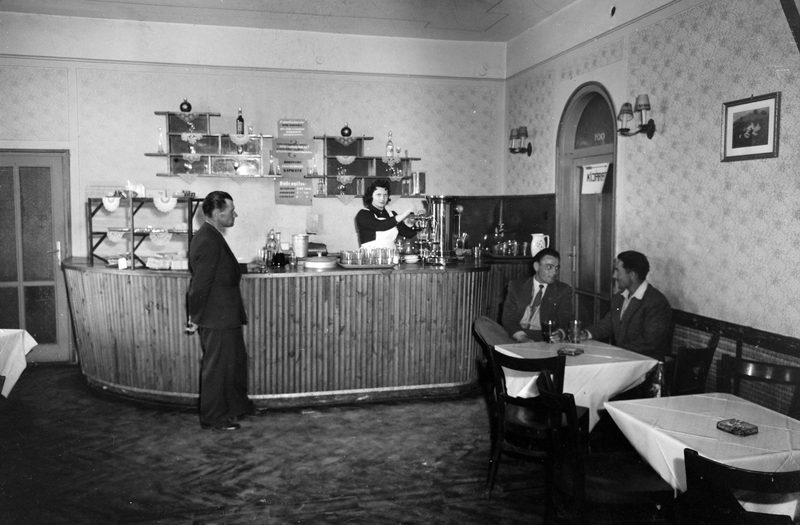
The counter of an espresso bar, with its coffee machine, 1955.
The counter of an espresso bar, with its coffee machine, 1955. Archive photograph. Credit: Fortepan / UVATERV

The Hungarian word "presszó" comes from this machine: the espresso maker was the star of the 1950s, and a whole culture grew around it. A good barman pulled a "dupla" in minutes; that was the measure behind the counter. Ours shows how it was done: look at the levers.

Here, human muscle pushed the water through the coffee.

  • The 1950s
  • Lever machine, around nine atmospheres
  • Look at the levers
Read more: Pressed, not dripped · The lever · The word presszó

Pressed, not dripped

Espresso means pressed: hot water forced through finely ground coffee in seconds rather than dripped through it. The first machines, patented in Italy in the early 1900s, worked on steam pressure and made a strong but often bitter cup.

The lever

The change came in the late 1940s, when Achille Gaggia's lever machine put a spring-loaded piston above the coffee. The barman pulled the long lever down to draw water in, then let go; the spring pushed the piston back and forced the water through the grounds at around nine times atmospheric pressure. That pressure produces the crema, the pale foam on top of a good shot, and it is why people still say they "pull" a shot on machines that have no lever at all.

The word presszó

Lever machines spread across Europe in the 1950s and gave Hungarian the word presszó, a clipped form of eszpresszó, for the places that served the coffee. A dupla is a double shot, a szimpla a single. Lever machines are still built today, mostly for people who like the ritual.

The Cash Register

The Cash Register. Illustration. Stylised model, not the venue's own object.
A pénztárgép
Look closerRead the indicator window at the top: those are the number wheels the clerk and the customer both watched.

The mechanical cash register set the rhythm of the presszó: every receipt was one pull of the lever. Calculator, printer and sound effect in one, the "digitalisation" of its day. Lean in close: the number wheels are still legible.

It rang, it clattered, and it never lost an argument.

  • Invented in 1879
  • Decorated brass or painted steel
  • Number wheels still legible
Read more: Dayton, Ohio, 1879 · Entirely mechanical · Built for decades

Dayton, Ohio, 1879

The mechanical cash register was invented in 1879 by James Ritty, a saloon owner in Dayton, Ohio, who wanted a machine that recorded every sale so the takings could be checked against the drawer at closing time. The company that grew from his patent, National Cash Register, sold the idea to shops and bars across the world.

Entirely mechanical

The workings are entirely mechanical. Pressing the keys sets the amount; pulling the crank or lever turns a set of numbered wheels that add it to the running total, pops indicator tabs up into a window so the customer can see the price, prints a line on the paper roll and springs the cash drawer open. The bell rang at the same moment, which is why a sale still "rings up".

Built for decades

Registers like this were heavy, often cast in decorated brass or finished in painted steel, and were built for decades of daily use. Their sound, a clatter of keys and a bell, belongs to the memory of every shop and presszó of the period.

The Bakelite Radio

The Bakelite Radio. Illustration. Stylised model, not the venue's own object.
A bakelitrádió
Look closerCheck the dial: the station names printed on the glass are a map of where the signal came from.

Before television, the radio was everyone's table companion. Football, news, dance music: the presszó listened together, and everyone had an opinion. The warmth of the bakelite box, the yellow glow of the dial: this was the screen of the 1950s.

Switch it on in your head: what was playing in 1954?

  • Bakelite, patented in 1907
  • Glass valves and a lit dial
  • News, dance music, football
Read more: The first synthetic plastic · Inside the box · Shared listening

The first synthetic plastic

Bakelite was the first fully synthetic plastic. Leo Baekeland patented it in 1907: a resin made from phenol and formaldehyde that is pressed into a heated mould, sets hard and never softens again. It does not conduct electricity, it tolerates heat, and it can be moulded into rounded shapes with lettering and grilles cast in, which made it the natural housing for radios, telephones and switches. Its colours were limited, mostly dark brown, black and marbled tones, because the resin itself is dark.

Inside the box

Inside a radio of the period sat glass valves that needed a minute to warm up before any sound came, a tuning dial lit from behind, and a large loudspeaker behind the cloth grille. In Hungary the Orion works in Budapest was a major maker, and small standard sets for the home were produced in large numbers in the 1950s.

Shared listening

In a presszó the radio stood behind or above the counter and was shared: the news at set hours, dance music in between, and on match days the football commentary, heard by everyone in the room at once.

The "Terv" Sign

The
A „Terv” névtábla
Look closerLook at the letter shapes: plain, wide sans-serif, the standard signwriting style of the 1950s.

The name "Terv" means "Plan", a word stamped on posters, boxes and shopfronts across 1950s Hungary. The presszó kept its name the way it kept its walls: it never rebranded with the times, it simply stayed itself.

This sign is not retro decoration: it is the name of the room.

  • Terv means plan
  • Painted or enamelled lettering on sheet metal
  • Wide sans-serif letters
Read more: A plain word · Names that stayed · The lettering

A plain word

Terv is the everyday Hungarian word for plan. It covers a holiday plan, an architect's drawing or a business plan, and in the years after 1947 it was also the word for the numbered national economic plans that organised Hungarian industry and trade: a Three-Year Plan from 1947 to 1949, then a Five-Year Plan from 1950. In that period the word appeared on posters, factory gates, product packaging and shop signs, and it was given to brands, buildings and places of all kinds; there was even a Terv brand of cigarette.

Names that stayed

Names like this outlived the plans themselves. Across Budapest a number of shops, cinemas and bars kept their mid-century names long after the original reason had faded, and the names turned into plain addresses in people's memory.

The lettering

A shop sign of the period was usually painted or enamelled lettering on sheet metal, or separate letters fixed to the facade, in the wide sans-serif faces of the time. This plate tells you what the room was called. What the word means today is up to the person reading it.

The Archive Photo Corner

The Archive Photo Corner. Illustration. Stylised model, not the venue's own object.
Az archív fotósarok
Look closerPick one photograph and find the same corner of the street outside. Then compare the shop signs.

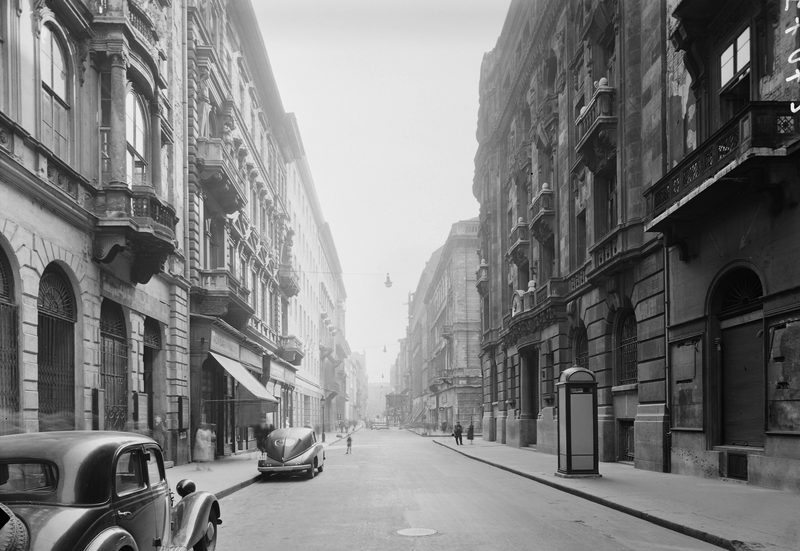
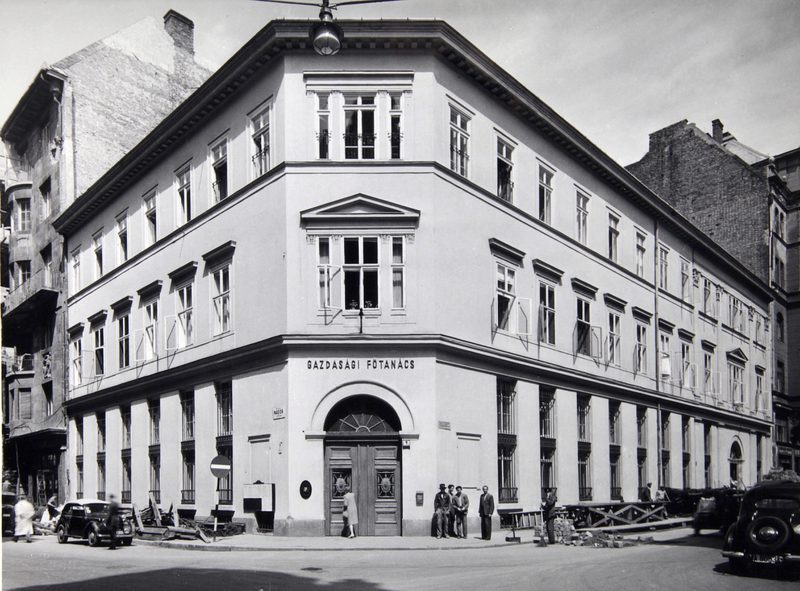
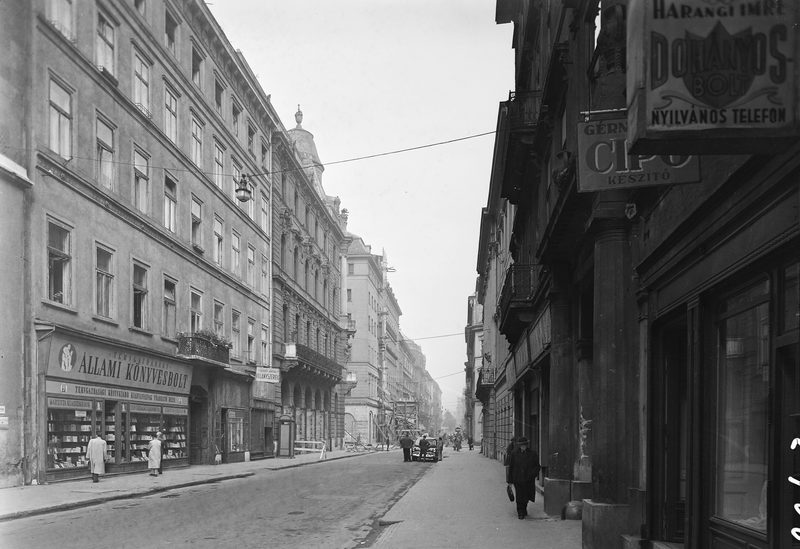
This is what the street looked like in those years. The photos show the Nádor utca of another era: Pobeda cars and Csepel bikes, passers-by in hats, the Parliament dome in the background.

Find what has changed in the pictures, and what has not changed at all.

  • Nádor utca, 1948 and 1955
  • Pobedas and Csepels
  • Compare with the street outside
Read more: The mounts · Looking slowly · The same facades

The mounts

An archive photo corner does two jobs. The mounts themselves, the small triangular pockets fixed to the wall or the album page, hold a print by its corners without any adhesive touching the photograph, so an old print can be shown and later removed unharmed; albums and archives have mounted photographs this way for a century.

Looking slowly

The corner as a place is for looking slowly. Street photographs from mid-century Budapest reward that. The cars are Pobedas, the Soviet-built saloon of the late 1940s and 1950s; the bicycles are Csepels, made at the works on Csepel island; men wear hats, shopfronts carry painted lettering, and the pavements are wider than the parked cars would allow today.

The same facades

Nádor utca runs through Lipótváros, the inner-city district behind the Danube bank, and much of its building line dates from the nineteenth century, which is why the same facades can be found in a photograph and outside the door. The game of an archive corner is comparison: hold the picture in mind, step outside, and see what the same view looks like now.

Nádor utca, looking from Arany János utca towards József nádor tér, 1955.
Nádor utca, looking from Arany János utca towards József nádor tér, 1955. Archive photograph. Credit: Fortepan / UVATERV
Nádor utca 9, corner of Zrínyi utca, 1948.
Nádor utca 9, corner of Zrínyi utca, 1948. Archive photograph. Credit: Fortepan
Context

The Golden Team, 1953

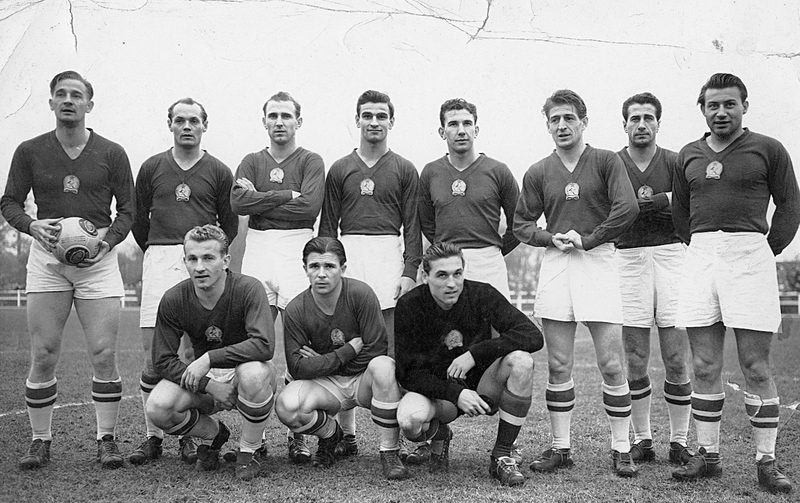
Hungary's national football team of the early 1950s is remembered as the Aranycsapat, the Golden Team. Its two famous afternoons, Wembley in 1953 and Bern in 1954, are still discussed in Hungary as if they happened last season.

The Golden Team, 1953.
The Golden Team, 1953. Archive photograph. Credit: Fortepan / Erky-Nagy Tibor

Gyula Lóránt, Jenő Buzánszky, Nándor Hidegkuti, Sándor Kocsis, József Zakariás, Zoltán Czibor, József Bozsik, László Budai II; crouching: Mihály Lantos, Ferenc Puskás, Gyula Grosics.

Soda water in Budapest

Soda water has a Hungarian inventor story that is on the record. In 1826 Ányos Jedlik, a Benedictine priest and physicist teaching in Győr, built an apparatus that dissolved carbon dioxide in water under pressure and produced artificial mineral water. In 1841 he set up a soda-water works in Pest. Siphons are still filled in Budapest today.

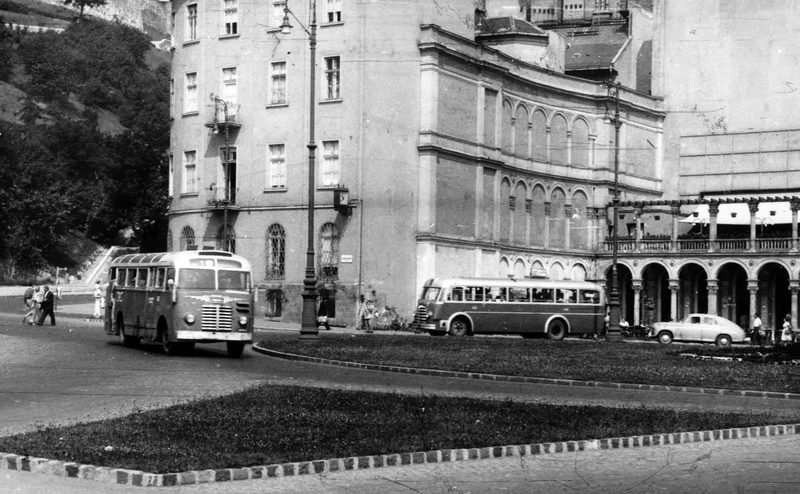
Clark Ádám tér, the terrace of the Lánchíd presszó on the right, 1954.
Clark Ádám tér, the terrace of the Lánchíd presszó on the right, 1954. Archive photograph. Credit: Fortepan / Vízkelety László

Enamel signs

Enamel is glass fused to metal. The result does not fade, does not absorb water and can be wiped clean after fifty years outdoors. Its weakness is impact: a knock chips the glass and exposes the steel, which rusts in a ring around the chip. The chips and rust on an old sign are its service record.

Nádor utca seen from József nádor tér, 1955.
Nádor utca seen from József nádor tér, 1955. Archive photograph. Credit: Fortepan / UVATERV

Visiting

  • Free to look. Walk in, look around, read the plates.
  • One dish is the ticket. Order a goulash, a langosh or anything else on the menu, and the room is yours for as long as you like.
  • Open daily, noon to midnight.
  • Nádor utca 19, 1051 Budapest.
  • Every story on the plates is known to the staff. Ask, and they will tell it.

No ticket needed. Just a menu.

Menu

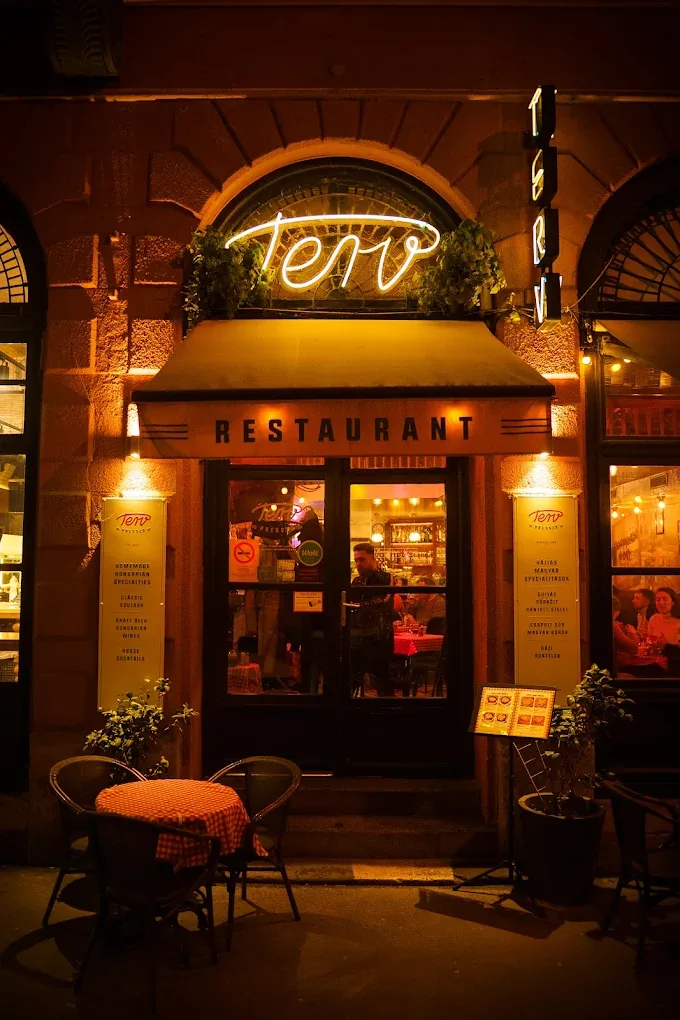
The front on Nádor utca.

Museum rules: touch with your camera only.

Illustration. Stylised model, not the venue's own object. Archive photographs: Fortepan / UVATERV; Fortepan; Fortepan / Vízkelety László; Fortepan / Erky-Nagy Tibor. Licence: CC BY-SA 3.0. creativecommons.org/licenses/by-sa/3.0